


The Soigneur’s Experience at Cape Epic by Iman
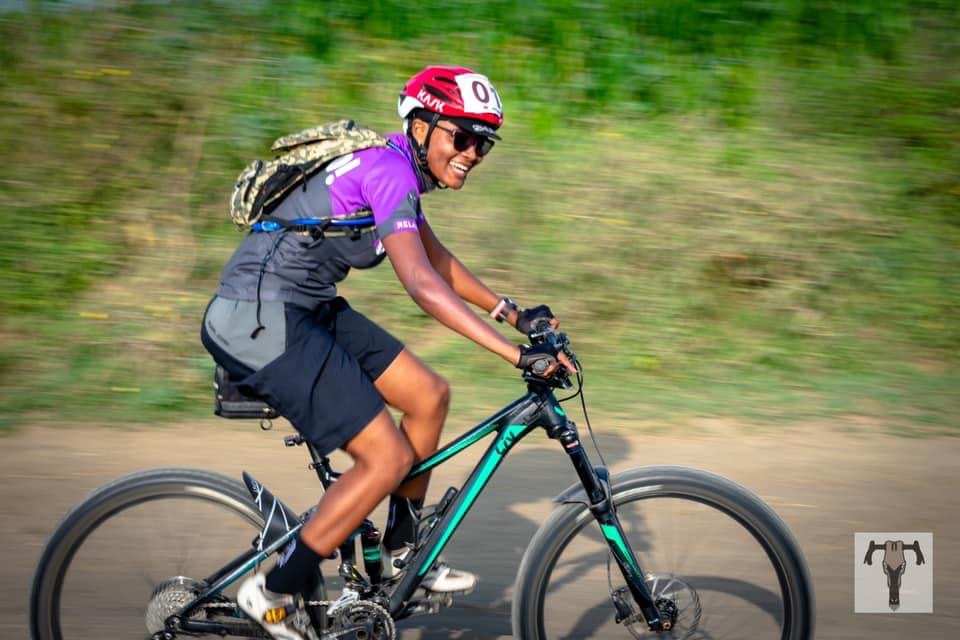
Cape Epic is one of the most notorious, challenging and sought-after events in mountain biking. Contributor Iman Achieng’ Kagumba shares her experience supporting riders throughout the 8 stages.
Words: Iman Achieng’ Kagumba
Photos: Iman Achieng’ Kagumba

A dream come true — for years, I had dreamt of racing the Cape Epic. I was inspired by Annika Langvad, who moved me so much during her years of racing with her partners at the time, but specifically Ariane Lüthi, the current team manager for Pump For Peace. I might not have raced the Epic YET, but the close-up experiences I had this year were exhilarating.
In this year’s Cape Epic, I was honoured to join Pump For Peace as a soigneur for their pro team.

Cape Epic is an 8-day race that takes place in the Western Cape of South Africa. Covering approximately 600–700 km with around 15,000–17,000 meters of climbing, it is one of the most demanding stage races in the world. The race moves through places like Durbanville, Paarl, Tulbagh, Wellington, and Lourensford, before finishing in Stellenbosch. With over 1,000 riders entering through a lottery system due to high demand, and queen stages pushing close to 3,000 meters of climbing, you are guaranteed some very solid days on the saddle. Just WOW.

My role as a soigneur included muscle therapy — trigger point therapy, myofascial release — as well as supporting recovery, preparing bottles, assisting at feed zones, and monitoring the riders’ condition before and after each stage. Being in this position placed me right in the middle of the drama, the intensity, and the precision it takes athletes to perform at such a high level.
Seeing myself and my practice (Refined Muscle Therapy) being appreciated by the top athletes on our team validated something I had questioned for a long time — whether my line of work truly made sense in this space.
My precision in muscle health not only supported faster recovery between stages, but also gave me insight into how each athlete used their body. I could immediately differentiate between those who relied more on endurance muscle patterns and those who did not. This allowed me to guide them on how to plan their riding and what areas might need strengthening beyond the race.

To have a pro athlete listen to you, trust you, and act on your advice in the middle of such a demanding race — that was something I had previously only imagined. In that moment, I felt seen.
Aside from the calm moments like these, there was the chaos.
Travelling across the Western Cape, trying to reach riders at designated water points, dodging penalties from commissaires (you cannot feed outside the cones — I did not see the cones!!!), the constant pressure, the adrenaline — it was relentless. There were moments of almost missing the athletes because getting to the next water point meant driving extra kilometres, parking far, sometimes uphill, grabbing bottles, realising you picked the wrong ones, running back, switching, running again.

At times, I found myself holding four bottles for four different riders (especially when helping other teams), and then they all arrived at once. You have seconds to react. You must give the right bottle to the right rider, without mixing anything up, and sometimes you don’t even know their names or faces. It was intense, chaotic, and strangely exhilarating.
After eight days of running around like that, my feet were completely shattered. Even now, I still feel some of the soreness as they heal.

Cape Epic is intense on every level — from the organisers managing over a thousand people, to the medics airlifting injured riders, to the vendors keeping everything running and sanitary. The scale of it is hard to comprehend. I read that it can take up to 72 hours non-stop just to build a single race village. WHATTTTTTT!
But beyond all of this — the scale, the chaos, the pressure — what stays with me is something deeper.
This experience shifted something in me. What once felt like a distant dream became something I could step into, contribute to, and be trusted within. It showed me that my work has a place at the highest level of sport.
Dreams are truly valid — but more than that, they are possible.

About Pump for Peace
Pump for Peace is something close to my heart. It is a global initiative founded by Velosolutions, built on a simple but powerful belief: that sport, and cycling in particular, has the ability to unite people regardless of race, gender, or religion. Their work centres on building pump tracks in underprivileged communities, making cycling and action sports accessible to people who might otherwise never get the chance to experience what we get to experience every time we clip in or hit a trail.
Having spent years seeing firsthand how cycling can shift a person's world, their confidence, their community, their sense of self, I know that access is everything. Pump for Peace gets that. It is not just about building infrastructure. It is about building futures, instilling passion, and showing young people in communities like the ones I grew up around that this sport belongs to them too.
If you want to learn more, get involved, or support the cause, head to pumpforpeace.com. Trust me, it is worth five minutes of your time.


Comments